
.png)
"I am proud of my three cultures: Korean, Vietnamese, and French" Lucie Brochard, fashion designer.

Updated: Aug 6
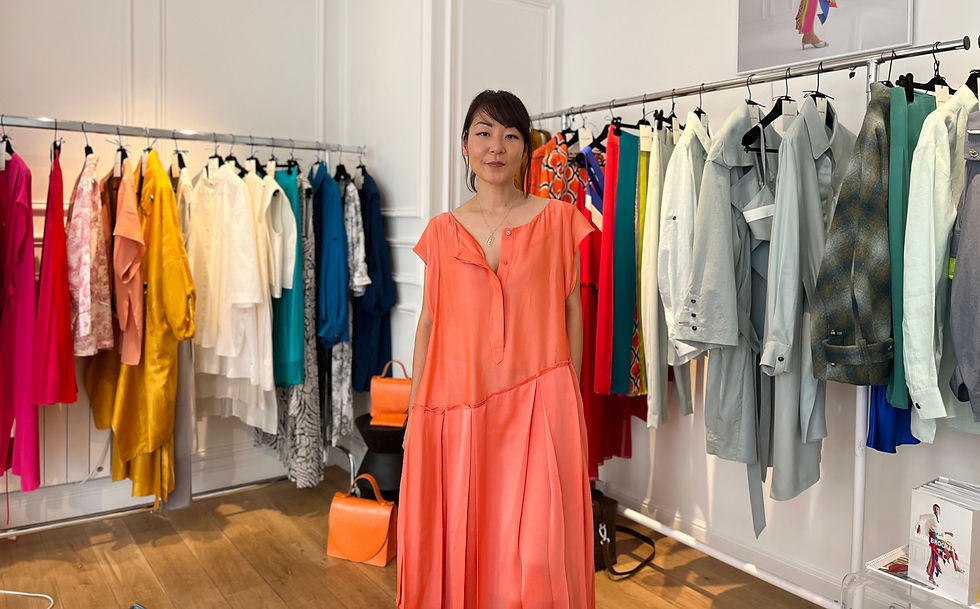
Born in South Korea in 1983 and adopted at the age of four alongside her sister, Lucie Brochard grew up in France with a French father and a Vietnamese mother. This unique journey shaped a multifaceted identity from an early age—one that now lies at the heart of her creations.
Written by Léa Baron 1/07/2026
"This three-culture background is essential—both to my upbringing and to my brand’s DNA. It defines my identity," says the designer, whom I met at her Parisian pop-up store (open until July 5 at 47 Rue du Four). There, she is showcasing her "Couleurs d’origine" (Colors of Origin) capsule collection, designed for the Korean market and premiered in Seoul last June to mark the 140th anniversary of diplomatic relations between France and Korea. For the fashion designer, it represents a return to her roots.
Having arrived in France as a child, she learned French in barely a month. "At that age, you’re like a sponge; you have to adapt." She retains few concrete memories of her early years in Korea—mostly vague impressions and dreams. Yet, the imprint remains. "It’s part of our history," she acknowledges. "And I think that naturally comes through in my designs, without me even consciously trying."
Her connection to Asian culture comes largely through her mother, who arrived from Vietnam at the age of twenty. She provided a demanding upbringing rooted in discipline and a strong work ethic: "Tomorrow is shaped by what you do today," she would tell them. "So build, work hard." It was a philosophy that would go on to shape her professional life.
Fashion: An Early Calling
For Lucie Brochard, fashion was an obvious calling from a very early age. As a child, she was constantly sketching, fascinated by clothes and their details. Her mother made the outfits she and her sister wore—often matching, floral-patterned ensembles.
The turning point came around the age of ten, when she discovered an Yves Saint Laurent fashion show. "I realized there was a profession linked to the very thing I’d always loved doing. It was incredible!" she says passionately. A family anecdote also resonates with her: "My older sister told me she remembers our biological father being a tailor." Without knowing if it is true, this instinctively driven woman feels it "makes sense"—and she takes the plunge.
At thirteen, she completes her first internship at Chloé, then under the creative direction of Stella McCartney. It proves to be a formative experience.
"I realized that the drawing wasn’t enough. What makes a collection is a vision: technique, craftsmanship, the creation of a world, a story, and a strong identity. Every detail contributes to giving meaning and coherence to the whole."
Several years of internships, observation, and learning followed. She attended fashion shows, wrote reports for a journalist, and honed her eye. Lucie Brochard continued her training at the Institut Français de la Mode—a prestigious school in Paris—graduating in 2007.

Learning about the world
A curious spirit, she pursued a wide range of international experiences—from San Francisco to Shenzhen—followed by stints at fashion houses such as Paule Ka and Christian Lacroix, from which she retained a particular fondness for the color fuchsia.
"I wanted to use my profession to travel, discover the world, work in different ways, and find inspiration."
These years of intensive training—demanding relentless work "night and day, weekends included"—enabled her to gain a comprehensive understanding of the trade: design, technique, and production, as well as the commercial and managerial aspects. Even so, she admits she is "still learning."
Vietnam: The Starting Point
Everything changed in Vietnam in 2013. Although she initially went there to discover her mother’s homeland, she ended up staying for two years. She explored, experimented, and learned. Living in a hotel room, she would sketch in the evenings and explore markets during the day. "I wanted to create my own wardrobe."
Above all, she discovered silk there—a material that would become central to her work. "At first, I found it too colorful and too warm," says the designer, who had previously favored black. "Then I asked myself how I could reinterpret it."
She began to develop a distinctive design language: structured silhouettes—inspired by the men's tailoring she loved—softened by the fluidity and variety of the fabrics.
Launched in 2015, her brand, LUCIE BROCHARD.võ, bears a name rich in meaning. "'Võ' is my mother’s name. It is a clear tribute to my Vietnamese roots, the silk used in my designs, and her craftsmanship."
Korean Inspirations
Her Korean heritage also resurfaced. After an initial trip over a decade ago, she was struck by the precision of the cuts and proportions. "For me, the cut is uncompromising. It is the foundation."

In 2016, she created a “flight A264” capsule, in reference to her first flight to Seoul and to mark the 130th anniversary of France-Korea diplomatic relations. She collaborates with the great Korean designer Lie Sang Bong and his son Lee Chung Chung, through the LIE brand.
At the time, Korean culture began to establish itself internationally, driven in particular by K-dramas whose styling fascinated her. A few years later, she will dress several K-drama actresses, including Kim Hye Soo in the series Hyena (2020).
The global phenomenon of Gangnam Style inspired him to create a costume of the same name. Lucie Brochard also remains influenced by major Korean artists like Lee Ufan. However, during her first trip, she maintained the look of an observer, almost a tourist.
“Ten years ago, I was in an outside position, curious, attracted by this growing culture”
Today, she observes a modern Korea, marked by a strong street wear culture: “T-shirts, sweatshirts… They have a very assertive style. »
Its “Original Colors”
Its latest capsule mixes these contemporary influences with traditional Korean references and Parisian aesthetics. “Colors of Origin” aims to appeal to the Korean market as part of the 140 years of France-Korea diplomatic relations.
“It’s a metaphor for my origins. A way of paying homage to my three cultures. »
In his creations we find references to jeogori (the top of the traditional hanbok) as well as a raincoat named after the dalgona biscuit, popularized by the Squid Game series. Above all, she revisits obangsaek, this typically Korean multicolored fabric, linked to a childhood memory: when they arrived in France, she and her sister had a small bag made from this textile. “It’s this world of colors that left its mark on me. That's how it all started. »

What is obangsaek?
Literally "colors of the five directions," obangsaek refers to the traditional Korean color palette—white, black, blue, red, and yellow—associated with the cardinal directions and the five elements (metal, water, wood, fire, and earth). It appears in many forms of expression, from textiles and architecture to cuisine, reflecting a quest for balance and harmony.
"I worked with the colors of Korea—bold tones like red, blue, black, and yellow, all deeply emblematic and rooted in obangsaek," she explains passionately. "I then reinterpreted them through my own prints. It creates a world that is highly colorful yet controlled."
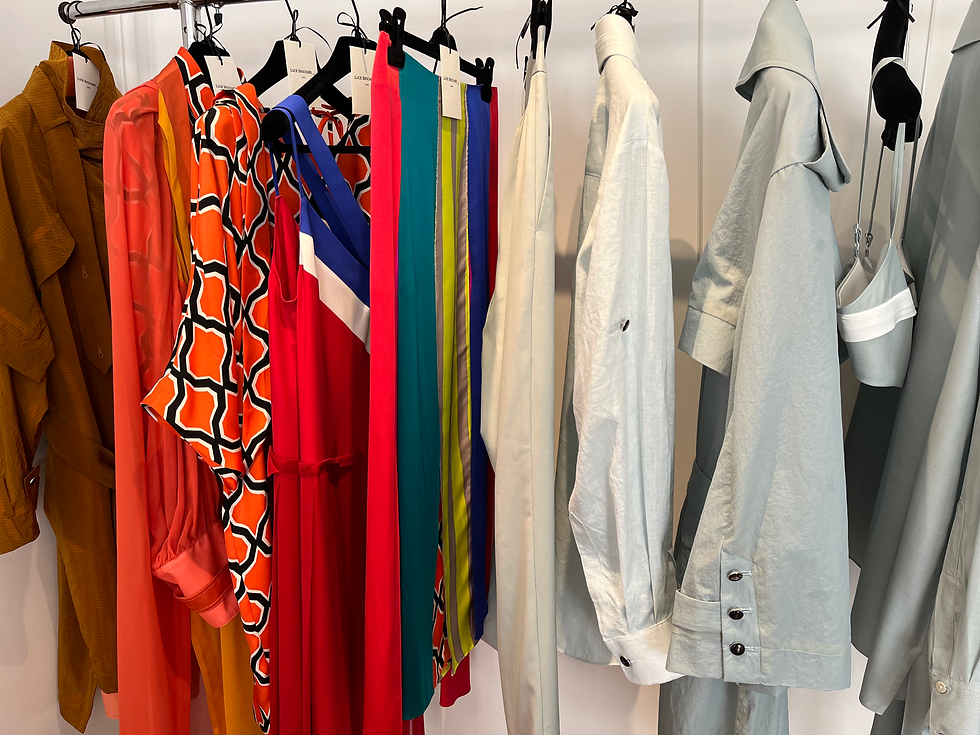
Korea weaves its way into several of her creations: the obangsaek palette appears in a skirt made of multi-printed "Obang" ribbons, a ruffled "Riboon Multicolor" dress, the sheer "Joseon" dress, and the "Han Leaf" skirt crafted from silk leaves.

"I like the piece to be complex in its construction, yet appear simple in the end."
Confident femininity
This allows her designs to convey the image of a strong woman—"independent, ambitious, and constantly pushing her own boundaries," as she puts it. For Lucie Brochard, "our power lies in our femininity—in asserting ourselves as women."
It is a femininity that finds different expressions in Europe and Asia, influencing her work in the process. In Asia, for instance, showing one's legs is more common than showing one's cleavage. "It’s not a question of values, but of differing cultural codes. There is often a greater sense of modesty, yet that certainly doesn't preclude a powerful femininity or genuine sensuality."
This vision is reflected in her designs: structured silhouettes—sometimes drawing inspiration from menswear—softened by lightness, sheer fabrics, and contrasting textures. It is a creative identity woven from three distinct cultures.
An open-minded global perspective
Today, her connection to Korea remains, above all, an emotional one.
"It is a part of me, no matter what. Even though I feel different from Korean people, I understand them."
She watches the country’s rise, its cultural influence, and its ability to make its mark on the global stage with admiration. Yet her own identity remains multifaceted: "My culture is French, shaped by a Vietnamese upbringing and Korean roots. I am proud of all three of my cultures!"


