
.png)
"At 30, I was determined to start a new life in France" Lee Young Kyung, chef at the Hanok restaurant in the Guimet Museum.

Updated: Aug 6

From fine arts to jewelry design, Lee Young Kyung ultimately dedicated her career to the culinary arts. As the chef behind the catering company Misso, she heads the kitchen at the Hanok restaurant within the Guimet Museum in Paris. Her work has notably included cooking for the group BTS during their first concert at the Stade de France in 2019. We met with Lee Young Kyung, 52, who says she owes everything to *hansik* (Korean cuisine).
Hansori: You are now a well-known Korean chef in France. Yet, you didn’t have any formal culinary training; your background is actually in fine arts, isn't it?
Lee Young Kyung: I was born in Anseong in 1974. After high school, I took the entrance exam for the fine arts program at Seoul National University. I failed the first time but succeeded on my second attempt. Initially, I chose this path somewhat by chance, as I didn’t really draw much. But then, I became truly passionate about it. I specialized in metalwork, glassblowing, jewelry design, and sculpture.
Was it through art that you decided to come to France?
Originally, I wanted to continue my studies. To me, France represented a global benchmark for art. I discovered the Alliance Française, and things moved very quickly after that. I obtained my visa in late November 2002 and arrived in Paris in January 2003. At 30 years old, I was determined to start a new life—a new chapter.
How did your arrival in France go?
I arrived alone, unable to speak the language, with only a Korean-English dictionary that didn’t really help me! Eventually, I realized that I didn’t want to go back to studying art. I signed up for a French course at the Sorbonne Nouvelle University. But it was too difficult—the genders, masculine and feminine forms... I didn’t understand a thing! It took me about two years to make progress.
Was that when you took your first steps in the culinary world?
Yes. I was hired by a caterer in the 13th arrondissement. I loved it right away. The customers—mostly French—were very kind and helped me improve my French. That’s also where I met my husband, who works with me today. At the time, he knew nothing about Korean cuisine or Korea itself. He grew to appreciate them by becoming a customer of the catering business. That’s how our story began.
And then you took over the business?
In 2006, when the owner closed up shop, I took over the business and started my own company, which I named Misso. It means "smile" in Korean.
Did you already cook before coming to France? Who taught you?
My mother, who ran a shop, did cook, but she worked long hours. It was mainly my paternal grandmother who taught me the basics. She was an excellent cook, well-known in her neighborhood. She used to prepare meals for family gatherings and get-togethers with friends—often for dozens of people.
What do you enjoy about cooking?
I love cooking because I love eating. But that’s not all. I love the sharing aspect and the ingredients—like *jang* (see sidebar below), those three fermented sauces and pastes that lie at the heart of Korean cuisine.
Jang: The Soul of Korean Cuisine

The term *jang* refers to a family of fermented sauces and pastes, primarily made from soybeans—specifically *meju*, bricks formed from cooked, crushed soybeans that are bound with rice-straw cords and hung to dry and ferment for several days. From this base come the three main types of *jang*: *ganjang* (soy sauce), *doenjang* (soybean paste), and *gochujang* (chili paste).
→ Read more in my book *Korea Cantina* (Hachette Pratique).
The science of fermentation stems from our history—particularly from times of war, when food had to be preserved without refrigeration. Vegetables were also dried in the summer to be eaten in the winter. This scientific and historical dimension fascinates me.

How would you define your cuisine?
It is traditional, family-style cooking rooted in the concept of sharing. In the past, people ate together and shared dishes—like *banchan*—whereas today, things are more individualistic. My cooking aims to convey that spirit: a convivial cuisine that is, above all, made from the heart.
In 2024, you secured a spot at the Musée National des Arts Asiatiques – Guimet, which was looking to open a restaurant on its premises. Did your catering work—particularly with the group BTS—play a role in this?
Thanks to my catering business, I was already accustomed to serving 200 to 300 people. In the coming days, for instance—after this interview—I’ll be catering for an OECD summit and an event in Le Mans. I have extensive experience in this field. In 2019, I was selected to handle all the catering for BTS during their first concert at the Stade de France in Paris.
That is how, in 2025, we opened the Hanok restaurant at the Musée Guimet, serving *hansik*—traditional Korean cuisine. And on the museum’s rooftop, we also have the Han Rooftop snack bar, where we offer a more street-food style menu.
Currently at the Guimet Museum: temple cuisine and the Kingdom of Silla.

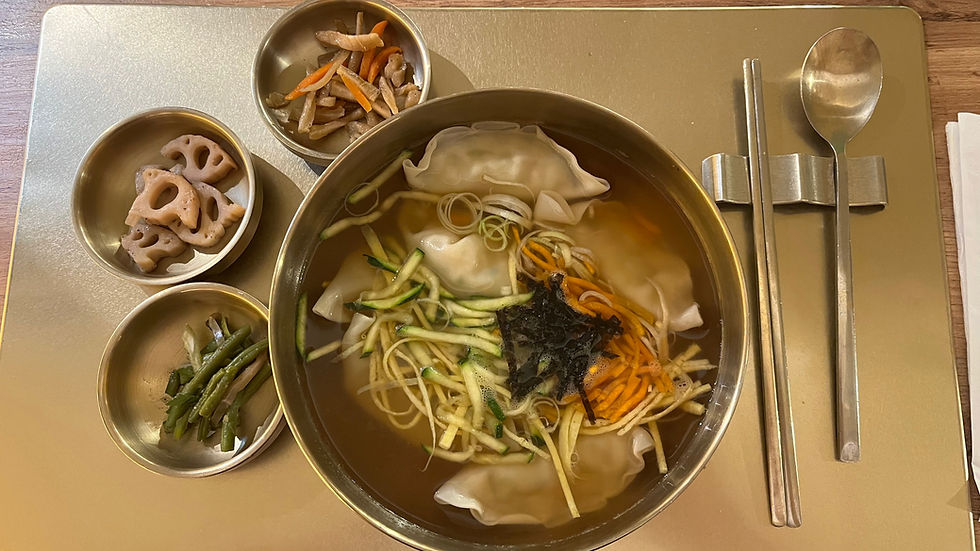
Until August 31, the Guimet Museum is showcasing a little-known civilization with the exhibition "Silla: Gold and the Sacred." For the first time in Europe, treasures from Korean royal tombs—including gold crowns, jade ornaments, jewelry, and funerary objects—have been brought together in Paris. For nearly a millennium (57 BC – 935 AD), the Silla Kingdom shaped a culture where power, art, and spirituality were inextricably linked, notably marked by the rise of Buddhism starting in the 6th century. Echoing this history, Chef Young Kyung Lee presents a menu inspired by "temple cuisine," a vegan culinary tradition rooted in Buddhist practices.
→ Discover the history of temple cuisine and an interview with nun-chef Jeong Kwan in my book *Korea Cantina*.
Has the popularity of Korean culture—the "Hallyu" wave—had a positive impact on your business?
Yes, but it took time. I started in 2006, and it wasn’t until about a decade later that I felt the effect. The real turning point came with Covid: people were watching Netflix at home, discovering Korean culture through series, and then wanting to taste the food, which features prominently in K-dramas.
Why is Korean cuisine so popular today?
Because it allows you to discover a culture through food. When I offer my catering services, I don't just present dishes, I share a real cultural experience.
How does your family perceive your life in France?
My parents are happy for me. They came to France several times. But living far from your family is not easy, it sometimes makes you a little nostalgic.
Are you considering moving back to Korea?
My husband would like to live in Korea: he really likes the country and my family. For the moment, I am used to my life in France, even if the administration there is sometimes complicated. But in Korea, there is a lot of competition and very little vacation.
Today, I am happy here, although it is not always easy to live between two countries.
Above all, I am grateful for what France has been able to give me.
Before, cooking was not my job, but thanks to my career here, I have met a lot of people and learned to share. Now, I want to pass it on, particularly through cooking classes.
You now offer your activity through a “Korean taste institute in France”. Can you explain its objective to us?
It is an institute that combines food and culture. The idea is to organize activities, including classes and events around Korean cuisine. The objective is also to train professionals, in particular future owners of Korean restaurants, or to help some to improve their skills.
I want to preserve authentic Korean cuisine, not just the recipes, but also the spirit. Today, Korean cuisine is very popular, but it is essential to preserve its identity.


